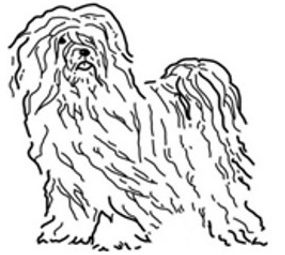
Below is some more information on the testing we suggest for the Tibetan Terrier breed. All information has been taken from the Kennel Club Website. Please visit their site to find out more about testing organisations and prices.
NCL12 – Neuronal Ceroid Lipofuscinosis
Details about the disease
It is one of a number of lysosomal storage diseases. Lysosomes are structures within cells that are responsible for breaking down and recycling unwanted cellular components and produce a number of key enzymes that are involved in this recycling process. Mutations in specific genes affect the efficiency of this process and cause the accumulation of intermediate chemicals to levels that can be toxic to cells, particularly to neuronal (nerve) cells. This leads to progressive neurodegeneration (degeneration of brain and eye cells) and results in severe neurological impairment and early death.
Clinical signs
Affected dogs appear normal at birth, but begin to exhibit clinical effects early in life – around 1-2 years of age. The age of onset and severity of the disease can vary greatly among individuals. The clinical effects include progressive motor decline with seizures and loss of coordinated muscle movements, cognitive decline (decline in mental processes such as learning, memory and attention) and abnormal behaviour. Visual impairment may occur.
PLL – Primary Lens Luxation
Details about the disease
In affected dogs, the zonular fibres which support the lens in the eye, breakdown or disintegrate, causing the lens to fall into the wrong position within the eye. If the lens falls into the anterior chamber of the eye, glaucoma and loss of vision can quickly result. PLL is a well-recognised, painful and blinding inherited eye condition that affects many breeds of dog.
Clinical signs
Clinical signs include reddening of the eye, glaucoma (increased pressure within the eyeball) and loss of vision, which can be detectable at 20 months. Complete lens luxation typically occurs at the age of 3-8 years.
PRA3 – Progressive Retinal Atrophy
Details about the disease
Progressive retinal atrophy (PRA) is an inherited condition that several breeds of dog are predisposed to. The condition is characterised by bilateral degeneration of the retina, causing progressive vision loss that culminates in total blindness. There is no treatment for PRA, of which several genetically distinct forms are recognised, each caused by a different mutation in a specific gene.
Clinical signs
Vision loss and eventual blindness.
PRA (RCD4) – Progressive Retinal Atrophy
Details about the disease
PRA-rcd4 (progressive retinal atrophy rod-cone degeneration 4) is a late-onset PRA mutation that causes bilateral degeneration of the retina which causes progressive vision loss, and eventually blindness. The average age of diagnosis for dogs with this form of PRA is 10 years, though there is considerable variation within breeds.
Clinical signs
The form rcd4 is characterised by puppies being born with perfect vision then developing night blindness in the first instance, before their sight begins to degenerate further later in life.
DP- LHX3 – Pituitary Dwarfism
Details about the disease
Pituitary dwarfism is a genetic condition caused by a growth hormone deficiency. This hormone is produced by the pituitary gland, hence the name ‘pituitary dwarfism’. Affected puppies may not be noticeably different at birth, but will not grow correctly and can die young.
Clinical signs
Affected dogs will be smaller than other dogs of the same breed and may remain puppy like in their appearance. Typically, dogs with pituitary dwarfism retain their soft puppy coat, may develop hair loss or have problems with tooth development.
Joint Health Statement
It is with regret that we have to inform you that an inherited condition called Pituitary Dwarfism has been diagnosed in Tibetan Terriers. It is a very debilitating condition which affects very young pups causing them to fail to thrive shortly after birth or where they do survive, they fail to grow to normal size along with the possibility of major organ failure and premature death.
This condition has been identified in German Shepherd dogs with a simple recessive mode of inheritance which means that it is caused by a single mutation of a gene. It is the same mode of inheritance as that of PLL, NCL, and PRA all of which we as a breed have dealt with in a very positive manner in order to produce healthier dogs and to reduce any suffering. It is hoped that we can embrace this new finding in the same manner for the benefit of the breed.
At present the test available for GSD’S is indicating the mutation is the same for TT’s. Of the TT’s tested so far affected dogs are showing two copies of the mutant gene and carriers are showing one.
We are strongly advising in these early days, whilst we become aware of the frequency and prevalence of the mutation that testing for Pituitary Dwarfism is done prior to any mating.
Tests can be ordered from animaldnadiagnostics.co.uk . We have negotiated a price reduction its original price of £48 to £36 for a period of 3 months to support the breed at this stage.
To monitor the prevalence of Pituitary Dwarfism the TTA and TTBOC would like to centrally collate any test results. When testing your dogs please consider completing this consent form and submitting the test results to one of the clubs. Your help will allow the clubs to better understand this condition.
Yet again this is a difficult time for breeders but we know that by supporting each other with care and compassion we will work to making our beloved breed a better and healthier one.
Pat Tempest TTA Chairman, Breed Health Coordinator
Philippa Gilbert TTBOC Chairman
 Tibetan Terrier Breeder and Owners Club